Note
Go to the end to download the full example code.
Whole BIDS datasets#
For a study, the same steps run on every recording of a BIDS dataset:
check them all, preprocess every run, epoch it, and combine the runs of each
session. meeg_utils.Dataset selects the recordings and
meeg_utils.process_dataset() takes them through every stage, resuming
an interrupted batch and collecting failures. The meu command does the
same from a terminal.
We first write MNE’s sample recording as a small BIDS dataset, with two
runs (its two halves), the empty-room recording and the Neuromag
calibration files.
import tempfile
from pathlib import Path

import mne
from mne_bids import BIDSPath, write_meg_calibration, write_meg_crosstalk, write_raw_bids

import meeg_utils as meu
from meeg_utils import steps as S

mne.set_log_level("ERROR")

data_path = mne.datasets.sample.data_path()
meg_dir = data_path / "MEG" / "sample"
raw = mne.io.read_raw_fif(meg_dir / "sample_audvis_raw.fif").load_data()
raw.info["line_freq"] = 60.0
event_id = {"auditory/left": 1, "auditory/right": 2, "visual/left": 3, "visual/right": 4}
all_events = {**event_id, "smiley": 5, "button": 32}

bids_root = Path(tempfile.mkdtemp()) / "bids"
for run, (tmin, tmax) in enumerate([(0, 138), (138, None)], start=1):
    part = raw.copy().crop(tmin, tmax)
    part_events = mne.find_events(part)
    path = BIDSPath(subject="01", session="01", task="audvis", run=run, root=bids_root)
    write_raw_bids(
        part, path, events=part_events, event_id=all_events, format="FIF",
        allow_preload=True, overwrite=True,
    )  # fmt: skip

er = mne.io.read_raw_fif(meg_dir / "ernoise_raw.fif").load_data()
er.info["line_freq"] = 60.0
er_path = BIDSPath(
    subject="emptyroom", session=er.info["meas_date"].strftime("%Y%m%d"), task="noise",
    root=bids_root,
)  # fmt: skip
write_raw_bids(er, er_path, format="FIF", allow_preload=True, overwrite=True)

meg_path = BIDSPath(subject="01", session="01", datatype="meg", root=bids_root)
write_meg_crosstalk(data_path / "SSS" / "ct_sparse_mgh.fif", meg_path)
write_meg_calibration(data_path / "SSS" / "sss_cal_mgh.dat", meg_path)
sorted(str(p.relative_to(bids_root)) for p in bids_root.rglob("*") if p.is_file())[:14]
['README', 'dataset_description.json', 'participants.json', 'participants.tsv', 'sub-01/ses-01/meg/sub-01_ses-01_acq-calibration_meg.dat', 'sub-01/ses-01/meg/sub-01_ses-01_acq-crosstalk_meg.fif', 'sub-01/ses-01/meg/sub-01_ses-01_coordsystem.json', 'sub-01/ses-01/meg/sub-01_ses-01_task-audvis_run-1_channels.tsv', 'sub-01/ses-01/meg/sub-01_ses-01_task-audvis_run-1_events.json', 'sub-01/ses-01/meg/sub-01_ses-01_task-audvis_run-1_events.tsv', 'sub-01/ses-01/meg/sub-01_ses-01_task-audvis_run-1_meg.fif', 'sub-01/ses-01/meg/sub-01_ses-01_task-audvis_run-1_meg.json', 'sub-01/ses-01/meg/sub-01_ses-01_task-audvis_run-2_channels.tsv', 'sub-01/ses-01/meg/sub-01_ses-01_task-audvis_run-2_events.json']
Select recordings#
Dataset selects recordings by BIDS entities and
groups the runs of each session and task. Empty-room recordings are left
out unless asked for:
ds = meu.Dataset(bids_root, datatype="meg")
ds.table()
[{'subject': '01', 'session': '01', 'task': 'audvis', 'acquisition': None, 'run': '1', 'datatype': 'meg', 'group': 'sub-01_ses-01_task-audvis_meg', 'path': '/tmp/tmpf3ax6brr/bids/sub-01/ses-01/meg/sub-01_ses-01_task-audvis_run-1_meg.fif'}, {'subject': '01', 'session': '01', 'task': 'audvis', 'acquisition': None, 'run': '2', 'datatype': 'meg', 'group': 'sub-01_ses-01_task-audvis_meg', 'path': '/tmp/tmpf3ax6brr/bids/sub-01/ses-01/meg/sub-01_ses-01_task-audvis_run-2_meg.fif'}]
Check them all#
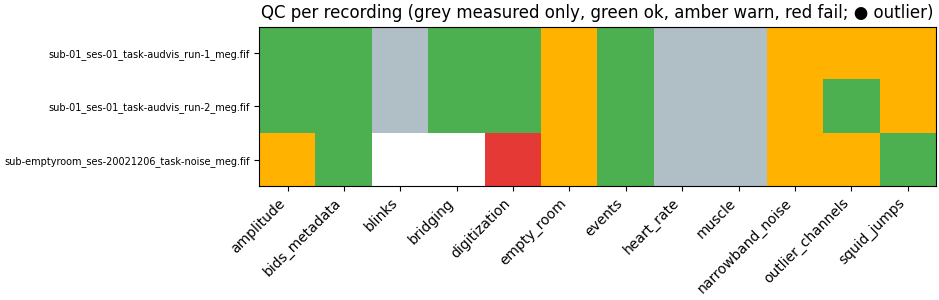
inspect_dataset() runs the acquisition checks on every
recording. In a BIDS dataset the checks also use the sidecars, the
calibration files and the session’s empty room:
result = meu.qc.inspect_dataset(bids_root)
result
<DatasetQC 3 recordings (0 info, 0 ok, 2 warn, 1 fail), 0 outlying metrics, 0 errors>
One row per recording and check: grey is measured only, green passed, amber and red need attention. With five or more recordings, a dot marks a recording that stands out from the rest of the dataset on a metric:
figs = result.plot()
first = next(iter(result.reports.values()))
print(first.checks["empty_room"].metrics_["mag"])
{'noise_floor': 3.989, 'unit': 'fT/√Hz', 'recording_above_db': 8.17, 'outlier_channels': ['MEG 0321', 'MEG 0411', 'MEG 0541', 'MEG 0631', 'MEG 2211', 'MEG 2441']}
Process every run#
Preprocessing runs on every run with its own copy of the pipeline; the
epochs stage runs on each preprocessed run, after mapping the MEG runs of a
session to their average head position; then the runs are combined.
Here the preprocessing is the front of the meg-erp preset (SSS, with
the calibration files found in the dataset), to keep the tutorial short:
preprocessing = meu.Pipeline(
    [
        ("bads", S.BadChannels("maxwell")),
        ("sss", S.Maxwell()),
        ("highpass", S.Filter(0.1, None)),
        ("resample", S.Resample(250.0)),
    ]
)
epochs = meu.Pipeline(
    [
        ("lowpass", S.Filter(None, 40.0)),
        ("epoch", S.Epoch(list(event_id), tmin=-0.2, tmax=0.5)),
    ]
)
deriv_root = bids_root / "derivatives" / "meu"
batch = meu.process_dataset(ds, deriv_root, preprocessing=preprocessing, epochs=epochs)
batch
<BatchResult
  preprocessing: 2 ok, 0 skipped, 0 failed
  epochs: 2 ok, 0 skipped, 0 failed
  combine: 1 ok, 0 skipped, 0 failed>
Every output is a BIDS derivative with a JSON sidecar holding the configuration, software versions, warnings and QC metrics of every step:
sorted(str(p.relative_to(deriv_root)) for p in deriv_root.rglob("*.fif"))
['sub-01/ses-01/meg/sub-01_ses-01_task-audvis_desc-epochs_epo.fif', 'sub-01/ses-01/meg/sub-01_ses-01_task-audvis_run-1_desc-epochs_epo.fif', 'sub-01/ses-01/meg/sub-01_ses-01_task-audvis_run-1_desc-preproc_meg.fif', 'sub-01/ses-01/meg/sub-01_ses-01_task-audvis_run-2_desc-epochs_epo.fif', 'sub-01/ses-01/meg/sub-01_ses-01_task-audvis_run-2_desc-preproc_meg.fif']
Calling process_dataset() again skips what exists, so an
interrupted batch resumes and failed runs are retried. batch.failed
lists the failures with their errors.
Review the results#
meeg_utils.report.summarize() collects the QC metrics of every
derivative into one table, with the warnings of every run:
summary = meu.report.summarize(deriv_root, desc="preproc")
summary.to_records()
[{'file': 'sub-01/ses-01/meg/sub-01_ses-01_task-audvis_run-1_desc-preproc_meg.fif', 'n_warnings': 0, 'outlier_metrics': '', 'bads.meg.n_bads': 1.0, 'bads.meg.fraction': 0.0032679738562091504, 'sss.n_basis': 72.0, 'sss.projs_removed': 3.0, 'sss.power_change_db.mag': -8.76, 'sss.power_change_db.grad': -2.25, 'highpass.highpass': 0.10000000149011612, 'highpass.lowpass': 172.17630004882812, 'resample.sfreq_before': 600.614990234375, 'resample.sfreq_after': 250.0}, {'file': 'sub-01/ses-01/meg/sub-01_ses-01_task-audvis_run-2_desc-preproc_meg.fif', 'n_warnings': 0, 'outlier_metrics': '', 'bads.meg.n_bads': 0.0, 'bads.meg.fraction': 0.0, 'sss.n_basis': 72.0, 'sss.projs_removed': 3.0, 'sss.power_change_db.mag': -9.58, 'sss.power_change_db.grad': -1.77, 'highpass.highpass': 0.10000000149011612, 'highpass.lowpass': 172.17630004882812, 'resample.sfreq_before': 600.614990234375, 'resample.sfreq_after': 250.0}]
and meeg_utils.report.from_derivative() rebuilds the report of a
single output (pipeline, parameters, QC metrics, provenance and the data):
fname = next(deriv_root.rglob("*_desc-preproc_meg.fif"))
meu.report.from_derivative(fname)
<Report | 8 titles | 9 items | sub-01_ses-01_task-audvis_run-1_desc-preproc_meg.fif  | 0.4 MB
 Derivative                                                                          | 0.0 MB
 Pipeline                                                                            | 0.0 MB
 bads                                                                                | 0.0 MB
 sss                                                                                 | 0.0 MB
 highpass                                                                            | 0.0 MB
 resample                                                                            | 0.0 MB
 Data                                                                                | 0.4 MB
 Provenance                                                                          | 0.0 MB
>
The same from the command line#
meu qc bids/ --out qc/
meu run --preset meg-erp --epochs \
    --option "event_id=[auditory/left, auditory/right, visual/left, visual/right]" \
    --sources bids/ --out bids/derivatives/meu
meu report bids/derivatives/meu --desc preproc
Total running time of the script: (2 minutes 24.727 seconds)