Note
Go to the end to download the full example code.
Epochs, artifact rejection and combining runs#
Preprocessing works on each run separately. Epoching is a second stage,
applied to each preprocessed run; the epochs of a session’s runs are then
combined. This tutorial cuts MNE’s sample EEG into epochs around the
auditory and visual stimuli, repairs or rejects the bad ones with
autoreject, and combines two runs.
import mne

import meeg_utils as meu
from meeg_utils import steps as S

mne.set_log_level("ERROR")

data_path = mne.datasets.sample.data_path()
raw = mne.io.read_raw_fif(data_path / "MEG" / "sample" / "sample_audvis_raw.fif")
raw.pick(["eeg", "eog", "stim"]).load_data()
raw.info["line_freq"] = 60.0
The sample recording is a single run. To show how runs are combined, we
treat its two halves as two runs, each preprocessed on its own (here only
a high-pass filter and an average reference, to keep the tutorial fast; in
practice the eeg-erp preset).
pre = meu.Pipeline([("highpass", S.Filter(0.1, None)), ("reference", S.Reference("average"))])
runs = [raw.copy().crop(0, 138), raw.copy().crop(138, None)]
clean_runs = [pre.fit_transform(run) for run in runs]
The epochs stage#
The eeg-erp epochs stage low-passes the data at 40 Hz, cuts epochs from
-0.2 to 0.5 s with a pre-stimulus baseline, and runs local autoreject (all
MNE-BIDS-Pipeline defaults). Only the events need to be given:
event_id = {"auditory/left": 1, "auditory/right": 2, "visual/left": 3, "visual/right": 4}
ep = meu.Pipeline.preset("eeg-erp", stage="epochs", event_id=event_id)
ep
epochs_per_run = [ep.fit_transform(run) for run in clean_runs]
epochs_per_run
[<Epochs | 158 events (all good), -0.2 – 0.499 s (baseline -0.2 – 0 s), ~38.5 MiB, data loaded,
 'auditory/left': 39
 'auditory/right': 39
 'visual/left': 40
 'visual/right': 40>, <Epochs | 98 events (all good), -0.2 – 0.499 s (baseline -0.2 – 0 s), ~25.0 MiB, data loaded,
 'auditory/left': 22
 'auditory/right': 25
 'visual/left': 26
 'visual/right': 25>]
The last fitted run: why epochs were dropped, and the average per condition:
print(ep.qc_["epoch"])
figs = ep["epoch"].plot("evoked")
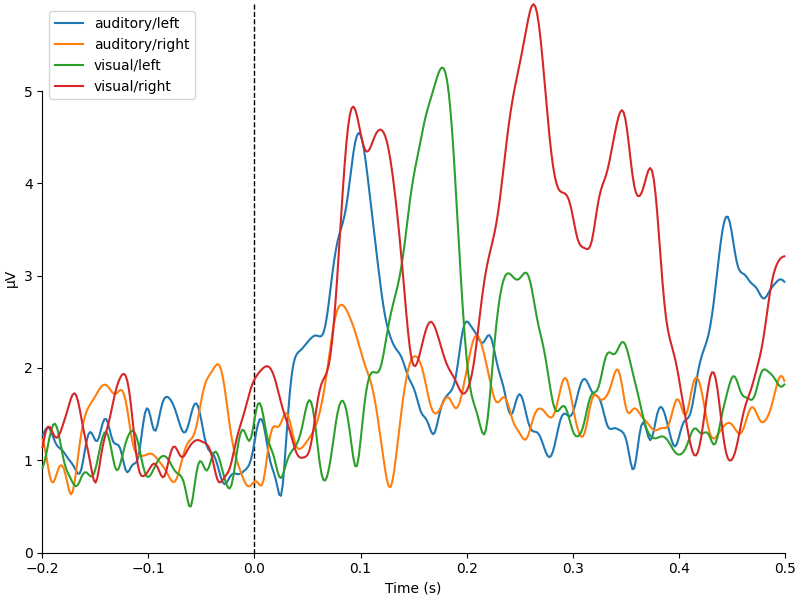
{'n_events_fit': {'auditory/left': 25, 'auditory/right': 26, 'visual/left': 26, 'visual/right': 27}, 'n_events': {'auditory/left': 25, 'auditory/right': 26, 'visual/left': 26, 'visual/right': 27}, 'n_kept': 104, 'n_dropped': 0, 'fraction_kept': 1.0, 'drop_reasons': {}}
autoreject#
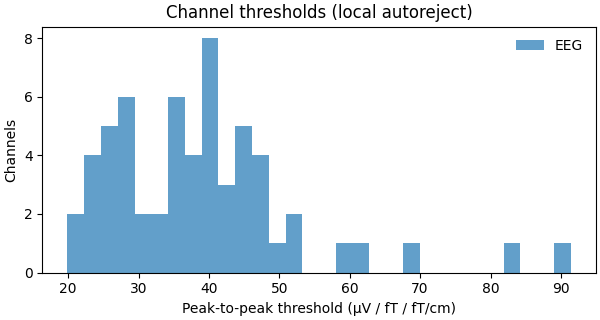
Local autoreject (Jas et al., 2017) learns a peak-to-peak threshold per channel. Within an epoch it interpolates the few channels above their threshold; epochs with too many bad channels are dropped. Each row is a channel and each column an epoch:
print({k: ep.qc_["autoreject"][k] for k in ("n_dropped", "fraction_dropped")})
figs = ep["autoreject"].plot("reject_log")
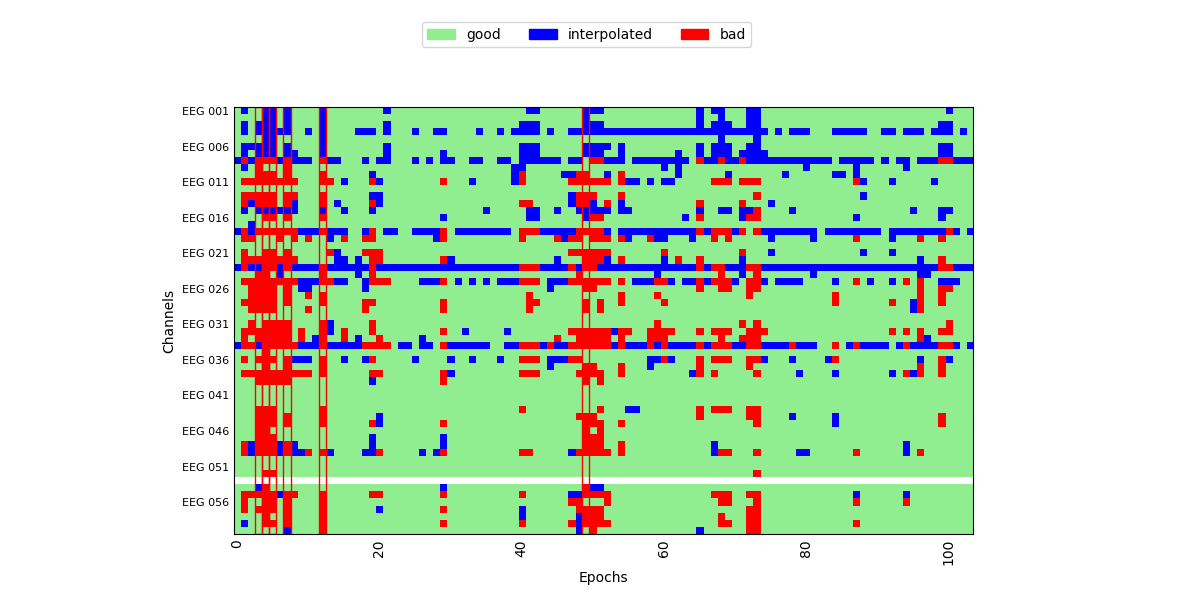
{'n_dropped': 6, 'fraction_dropped': 0.0577}
and the learned thresholds:
figs = ep["autoreject"].plot("thresholds")
Combine the runs#
meeg_utils.epochs.combine() concatenates the runs after checking
that they agree: the same event codes, the same channels (a channel bad in
one run is marked bad in all, bads="union"), and for MEG a head
position within 2 mm (otherwise map the runs to a common head position
first with HeadAlign).
epochs = meu.epochs.combine(epochs_per_run)
epochs
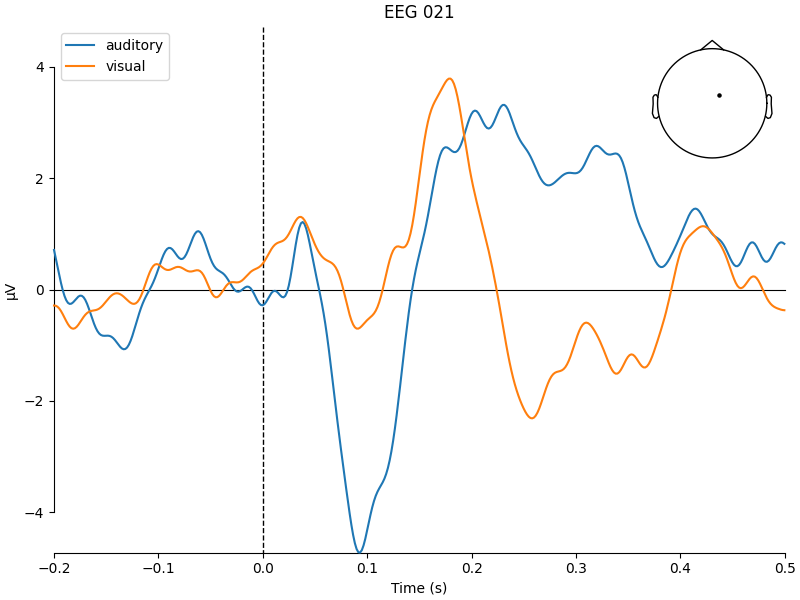
evokeds = {cond: epochs[cond].average() for cond in ("auditory", "visual")}
mne.viz.plot_compare_evokeds(evokeds, picks="EEG 021", show=False)
[<Figure size 800x600 with 2 Axes>]
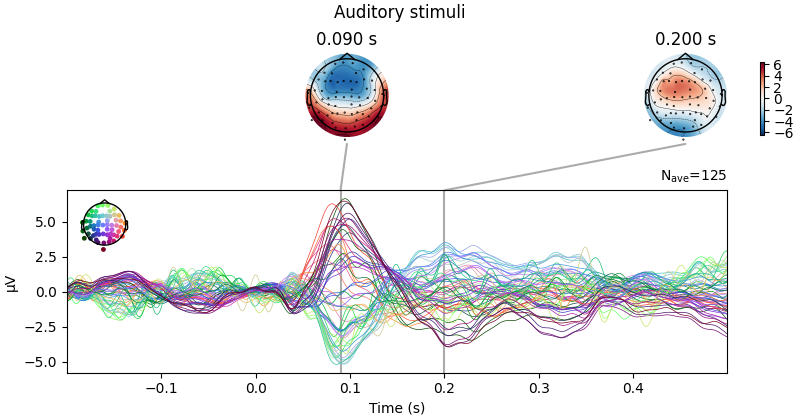
evokeds["auditory"].plot_joint(times=[0.09, 0.2], title="Auditory stimuli", show=False)
Resting state#
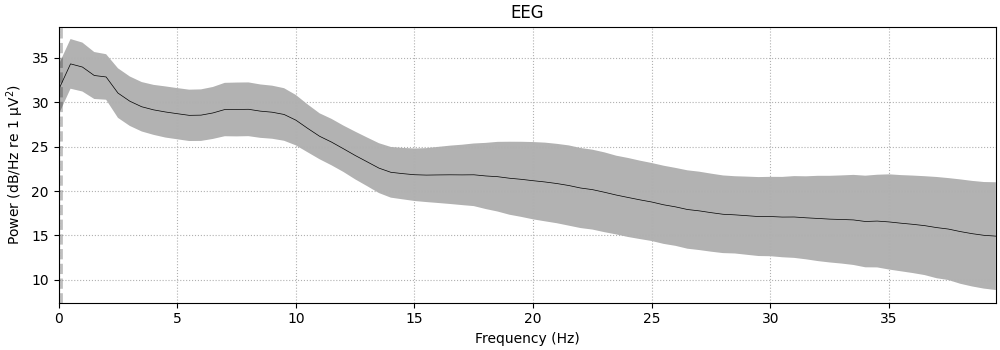
Without events, the *-rest presets cut consecutive windows of a given
length (the frequency resolution of later spectra is 1 / length):
rest = meu.Pipeline.preset("eeg-rest", stage="epochs", epoch_duration=2.0)
windows = rest.fit_transform(clean_runs[0])
windows.compute_psd(fmax=40).plot(average=True, amplitude=False, show=False)
Total running time of the script: (0 minutes 26.575 seconds)