Note
Go to the end to download the full example code.
Acquisition quality control#
Before cleaning a recording, check how well it was made: a flat channel, a loose EOG electrode, a head that moved, or a sidecar that disagrees with the data are better found the day the data were recorded than months later.
meeg_utils.qc answers these questions without changing the data. This
tutorial runs it on MNE’s sample recording (Neuromag MEG and EEG).
import mne

import meeg_utils as meu
from meeg_utils import qc

mne.set_log_level("ERROR")

data_path = mne.datasets.sample.data_path()
meg_dir = data_path / "MEG" / "sample"
raw = mne.io.read_raw_fif(meg_dir / "sample_audvis_raw.fif").load_data()
raw.info["line_freq"] = 60.0
Run every check#
inspect() picks the checks that apply to the data
(MEG, EEG, the acquisition system, BIDS) and lists the others with the
reason they were skipped:
report = qc.inspect(raw)
print(report)
<QCReport /home/runner/mne_data/MNE-sample-data/MEG/sample/sample_audvis_raw.fif level='warn'>
  ok   amplitude
  ok   bridging
  warn outlier_channels
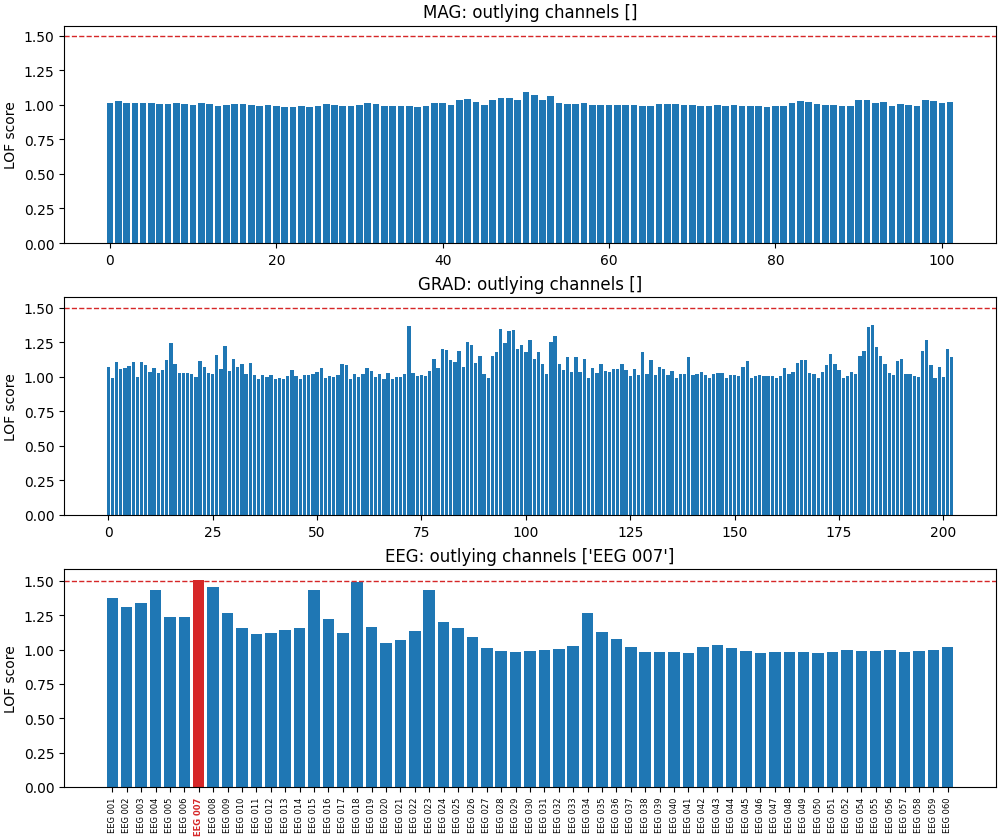
         - outlying EEG channels (LOF > 1.5): 1 (> 0); EEG 007
  warn narrowband_noise
         - GRAD channels with unusually strong line noise: 2 (> 0); check their contact: MEG 1033, MEG 1042
         - EEG channels with unusually strong line noise: 1 (> 0); check their contact: EEG 025
  info muscle
  info blinks
  info heart_rate
  warn squid_jumps
         - SQUID jumps: 8 (> 0); in ['MEG 2313']; mark the channels bad or annotate the jumps
  ok   digitization
  ok   events
  skip impedance: found no impedances in the recording (pass impedances=...)
  skip head_movement: found no continuous head localization (cHPI) in the recording
  skip chpi_snr: found no continuous head localization (cHPI) in the recording
  skip empty_room: needs an empty-room recording (the recording is not in a BIDS dataset)
  skip bids_metadata: the recording is not in a BIDS dataset
Each finding has a level:
fail/warnA problem by definition (a flat channel, a SQUID jump, a bridged electrode, a sidecar that disagrees with the data) or a channel that stands out from the others in this recording.
okThe criterion was checked and passed.
infoA measurement without a verdict: head movement, blink rate, heart rate, muscle activity, … Their normal range depends on the participants and the setup (children move more than adults, passive electrodes have higher impedances than active ones), so meeg-utils does not pretend to know it.
report.flags lists the problems, worst first:
for finding in report.flags:
    print(f"{finding.level:4}  {finding.check}: {finding.message}")
warn  outlier_channels: outlying EEG channels (LOF > 1.5): 1 (> 0); EEG 007
warn  narrowband_noise: GRAD channels with unusually strong line noise: 2 (> 0); check their contact: MEG 1033, MEG 1042
warn  narrowband_noise: EEG channels with unusually strong line noise: 1 (> 0); check their contact: EEG 025
warn  squid_jumps: SQUID jumps: 8 (> 0); in ['MEG 2313']; mark the channels bad or annotate the jumps
Look at what was measured#
Every check draws what it measured. Channels that stand out from the others (Local Outlier Factor, per channel type):
figs = report.checks["outlier_channels"].plot()
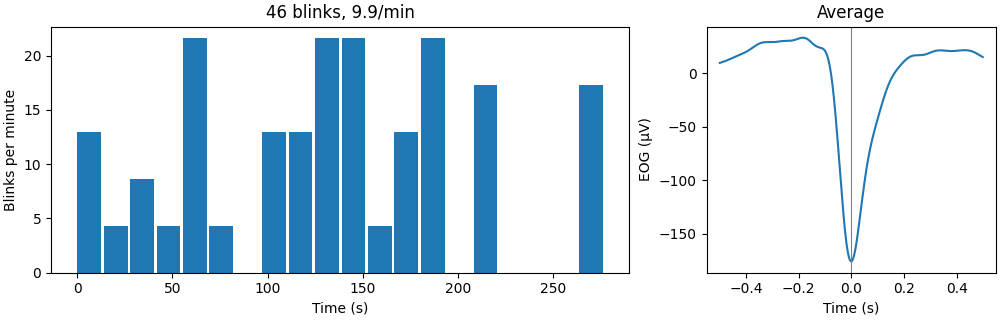
Blinks show whether the EOG electrodes work; the average blink should look like one:
figs = report.checks["blinks"].plot()
Without an ECG channel, MNE builds a synthetic ECG from the magnetometers. meeg-utils judges the heartbeat detection by how regular the intervals between beats are, and does not report a rate it cannot trust:
print(report.checks["heart_rate"].metrics_)
figs = report.checks["heart_rate"].plot()
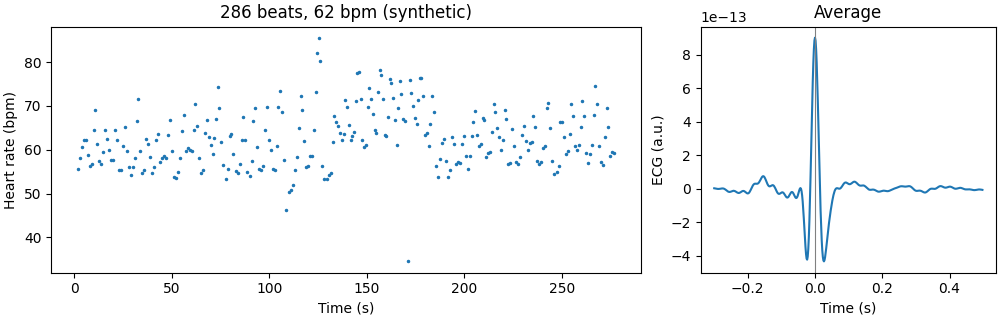
{'heart_rate_bpm': 62.0, 'reliable': True, 'n_beats': 286, 'rr_sd_ms': 104.6, 'irregular_fraction': 0.007, 'channel': 'synthetic'}
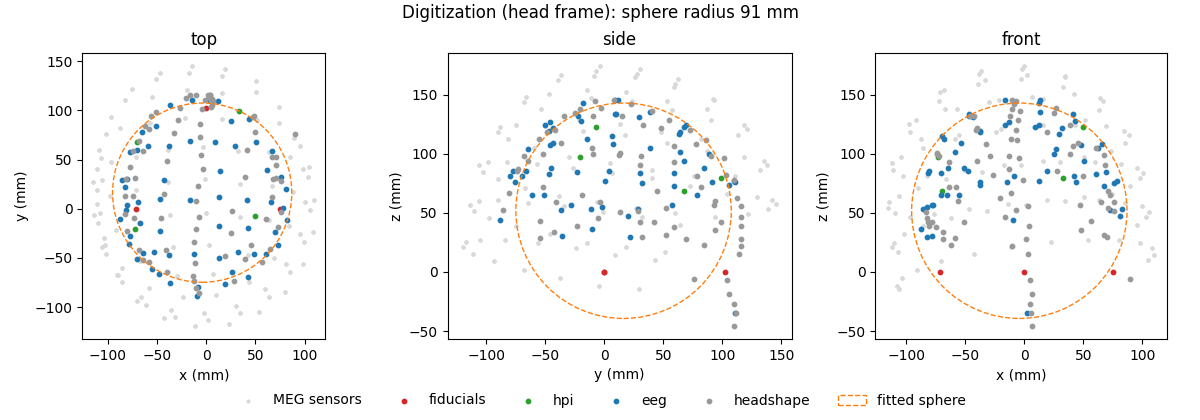
The digitized head shape, the sphere fitted to it, and the MEG sensors:
figs = report.checks["digitization"].plot()
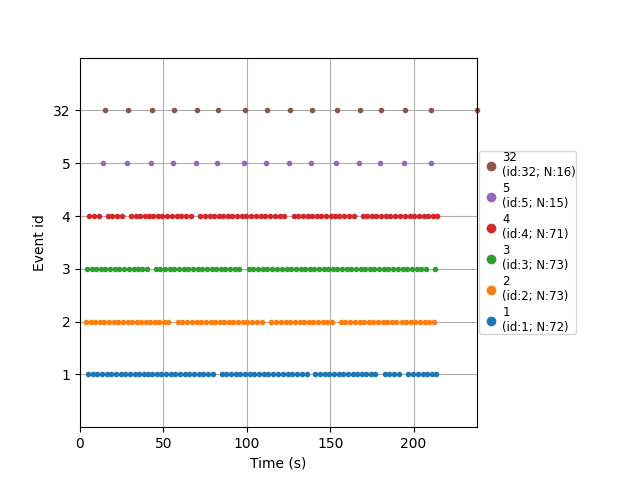
The events found in the recording:
figs = report.checks["events"].plot()
The empty room#
The empty-room recording of the session shows the noise of the sensors and the room on the day. In a BIDS dataset it is found automatically; here we pass the file:
er = qc.EmptyRoom(empty_room=meg_dir / "ernoise_raw.fif").compute(raw)
print(er.metrics_["mag"], er.metrics_["grad"], sep="\n")
figs = er.plot()
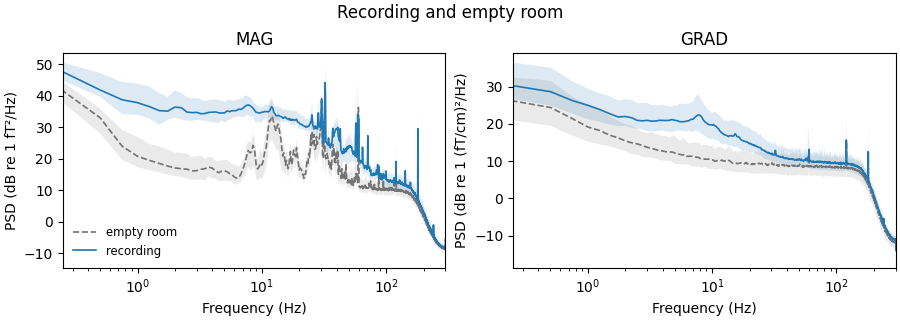
{'noise_floor': 3.989, 'unit': 'fT/√Hz', 'recording_above_db': 8.23, 'outlier_channels': ['MEG 0321', 'MEG 0411', 'MEG 0541', 'MEG 0631', 'MEG 2211', 'MEG 2441']}
{'noise_floor': 2.718, 'unit': 'fT/cm/√Hz', 'recording_above_db': 1.5, 'outlier_channels': ['MEG 0613', 'MEG 1332', 'MEG 2422']}
Your own thresholds#
The measurements reported as info become verdicts when you give them a
threshold that fits your participants and equipment. Every threshold is a
parameter of its check:
report = qc.inspect(
    raw,
    checks=[
        qc.Blinks(min_rate=5),  # blinks per minute
        qc.Muscle(warn_fraction=0.05),  # share of the recording
        qc.Events(expected={"1": 72, "2": 73, "3": 73, "4": 71}),
    ],
)
print(report)
<QCReport /home/runner/mne_data/MNE-sample-data/MEG/sample/sample_audvis_raw.fif level='ok'>
  ok   blinks
  ok   muscle
  ok   events
A whole dataset#
Across many recordings the info measurements get a reference: the rest
of the dataset. inspect_dataset() runs the checks on
every recording of a BIDS dataset and flags the recordings that stand out
on any metric (modified z-score above 3.5):
result = meu.qc.inspect_dataset("bids/", n_jobs=8)
result.outliers          # recording, metric, value, z
result.to_csv("qc/summary.csv")
result.plot()["levels"]  # recordings x checks
or from the command line: meu qc bids/ --out qc/, which also writes an
HTML report per recording with meeg_utils.report.build():
html = meu.report.build(qc=qc.inspect(raw), title="QC of sample_audvis_raw")
html
<Report | 1 title | 13 items | QC of sample_audvis_raw  | 0.4 MB
 Quality checks                                         | 0.4 MB
>
Total running time of the script: (0 minutes 49.835 seconds)